

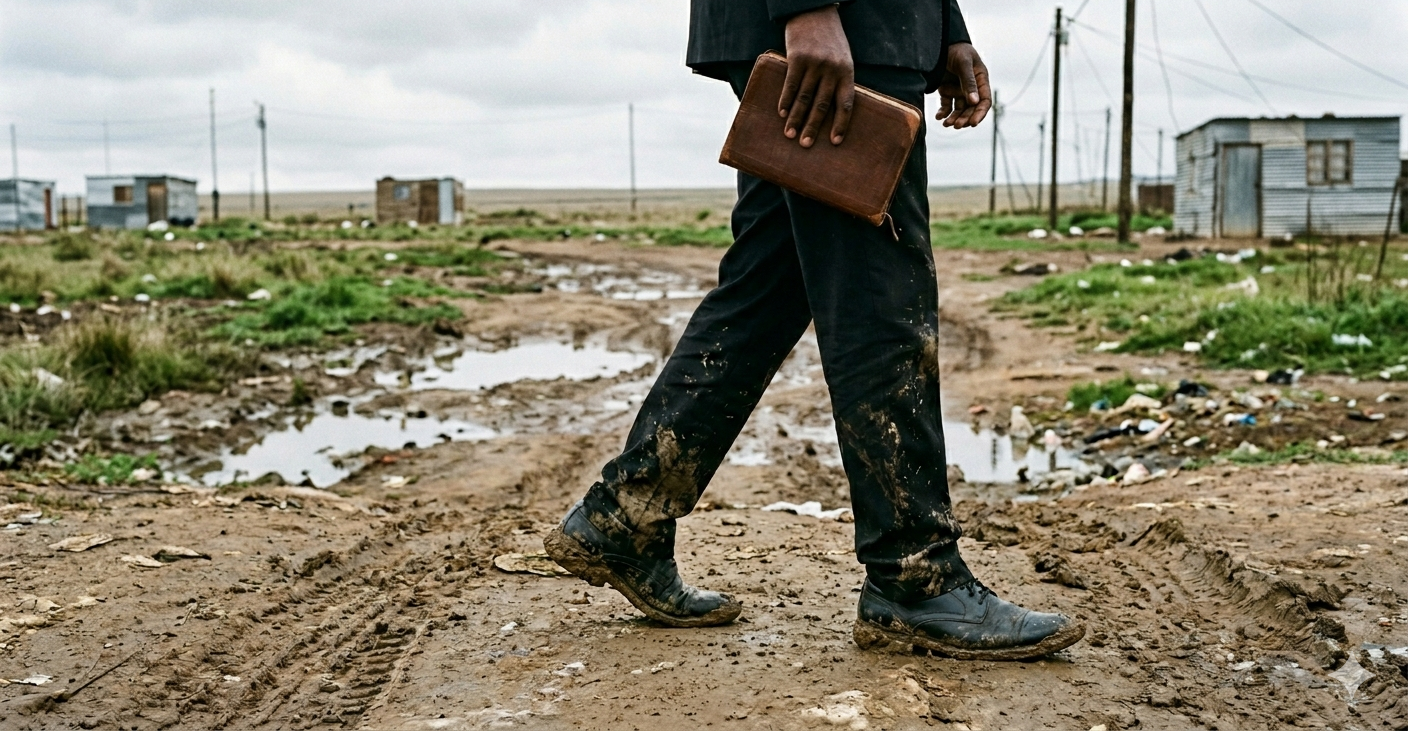
From the Comfort of the Pew to the Mud of Munsieville
On Sunday, the 17th of May 2026, I stepped out of the routine of comfortable Sunday fellowship and into a reality that shattered any sense of spiritual complacency. As part of the Salvation Army Krugersdorp Corps delegation, we partnered with the African Enterprise Foxfire mission team for an outreach open-air event in Munsieville, Krugersdorp in the West Rand. Munsieville is one of the oldest townships in the West Rand, located just outside Krugersdorp in Gauteng Province. It grew from informal settlements established for mine labourers working in the original Krugersdorp mining town. Our day began with a visit to the Krugersdorp Family Care Centre, but it was when we moved into the heart of the informal settlements that the stark reality of our calling hit home.
What I witnessed there moved me to my core. I saw deep, systemic poverty and squalid living conditions. Yet, shining through the harshness of that environment was something beautiful and convicting: an insatiable appetite for Jesus Christ. The people in these communities are hungry for the Gospel. They are crying out for salvation, for hope, and for a tangible expression of God’s love. But as I looked at their hunger, I was forced to look back at ourselves.
The Illusion of Engagement
Too many of us in different churches today have adopted a “business as usual,” casual approach to our faith. We gather in the warmth and comfort of our beautiful buildings, sing our praises, exchange pleasantries, and then drive back to our secure, comfortable homes.
We have mastered the art of talking about the poor, the downtrodden, the hungry, and the marginalized. We preach sermons about them. We analyse their plight based on what we see in the media. In this modern era, we even use sophisticated AI tools to generate stunning graphics of ministry, poverty, and outreach. But do we actually know what these people are experiencing? Have we touched the mud? Have we looked into the eyes of a mother wondering how she will feed her children in a shack that leaks when it rains?
Graphics and media statistics cannot replace presence. We have substituted actual proximity to suffering with digital and rhetorical awareness. We praise mercy and compassion from the safety of the pulpit, but we rarely cross the tracks to practice it.
The Radical Roots of Our Movement
This disconnect is precisely why the Salvation Army exists.When our founder, William Booth, walked through the slums of London’s East End in the 19th century, he was appalled—not just by the poverty, but by the elitist, out-of-touch approach of the established churches. He saw a church culture that regarded the marginalized, the addicted, and the disadvantaged as a scourge, a social pandemic, and as “untouchables.”
The mainstream church wanted to grow the Kingdom, but only with people who looked proper, smelled nice, and could contribute to the building fund. Booth fundamentally rejected that hypocrisy. He broke away from the traditional church because he realized that to win souls for Christ, you must be willing to go where the misery is heaviest. He understood that you cannot preach salvation to a starving person without offering a bowl of soup, and you cannot preach hope while remaining at a distance.
The Salvation Army was forged in the fires of active, aggressive, frontline warfare against poverty and spiritual darkness. It was never meant to be an elite club or a comfortable Sunday ritual.
Dismantling the Juxtaposition
Today, we live amidst a jarring juxtaposition of extreme poverty and immense affluence. In Krugersdorp, these two worlds exist mere kilometres apart. For the Church to remain inside its walls while Munsieville starves for the Word and for basic dignity is a betrayal of the Gospel we claim to defend. It is all talk and no action. Our outreach on May 17th proved that the harvest is truly plentiful, but the labourers are too often resting in the shade.
The Salvation Army must urgently revive its original drive, its radical focus, and its frontline identity. We need to dismantle this casual, comfortable approach to ministry. It is time to get our boots dirty again. We must move beyond the safety of our sanctuaries and the aesthetics of our media campaigns, look at what is actually happening on the ground, and do something about it.
Christ did not stay in heaven to save us; He came down into our broken world. If we are to be His hands and feet, we must leave the comfort of the pews and meet His people exactly where they are—in the streets, in the slums, and in the harvest fields of Munsieville.
Watch this space. Revival at Krugersdorp Corps is coming soon. I was there with a passion like William Booth. Thank you Thabiso for taking us too where people need God. As Vachel Lindsay’s poem says “Every slum had sent it’s half-score, the round world over (BOOTH HAD GROANED FOR MORE.)”